Mary Faith
The first person who taught me that Montana was more than land.

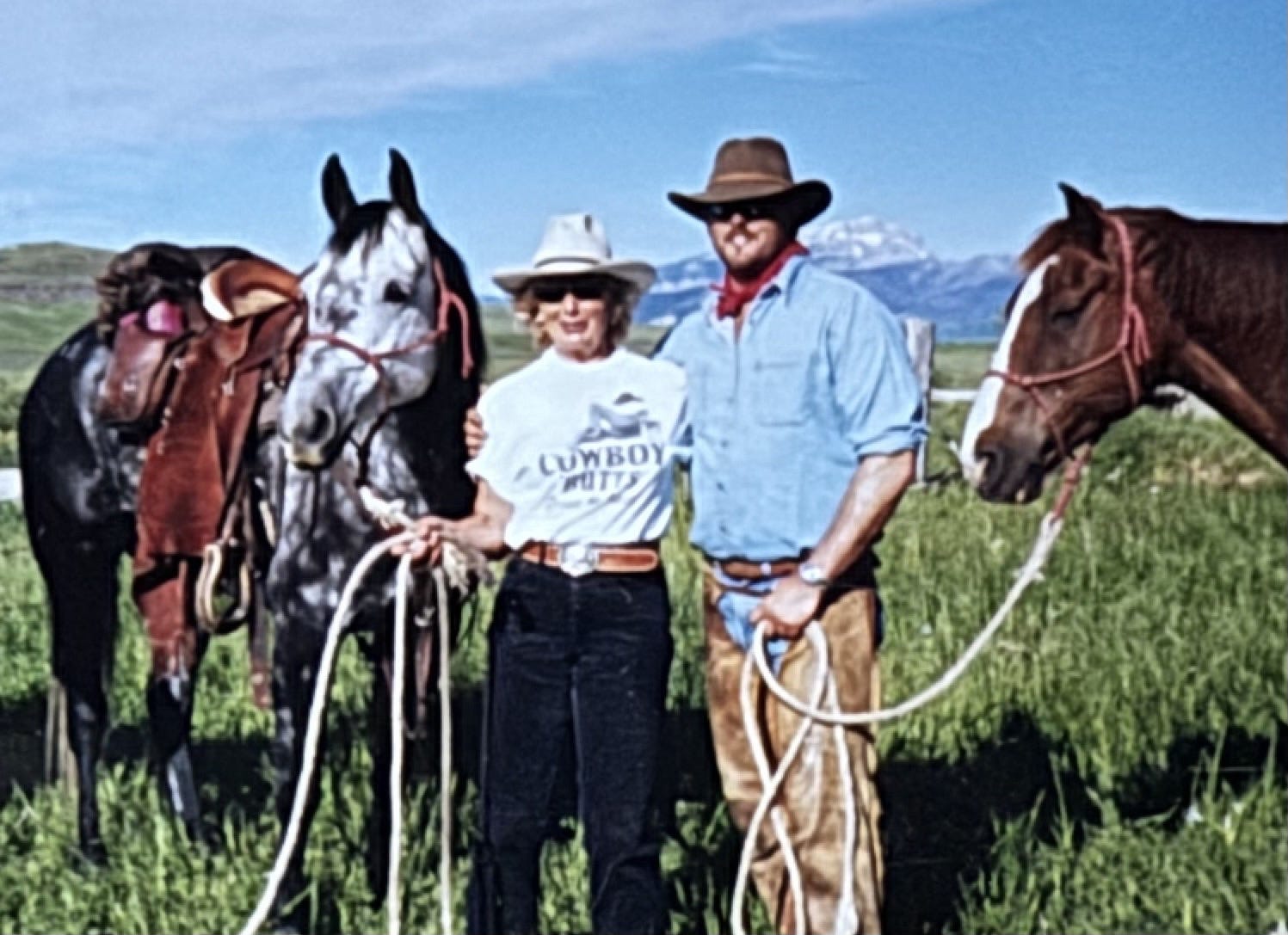
One leg stuck straight out in front of her, wrapped in white bandages from the ankle to well above the knee.
It was winter in Helena.
The old radiator heaters pinged and clicked from time to time as they pushed warm air through the room. The heat carried a faint smell of wet wool coats, melting snow, and old government buildings. It wasn’t the dry warmth of a wood stove. There was moisture in the air. The kind of heavy heat that settled into a room after a long Montana winter.
An older blonde woman sat near the front of the room. There was something distinguished about her.
Her injured leg rested straight out before her, but there was nothing delicate about the woman.
Her presence filled more of the room than the bandages.
She wasn’t looking for sympathy. She certainly wasn’t looking for pity. She sat quietly listening to the proceedings as though the injured knee was merely an inconvenience that would pass in due time.
Even then, I could tell she was someone who had lived.
Not merely existed. Lived.
I would later learn that she had spent a lifetime riding horses, running an outfitting business, raising a family, enduring hardship, and finding a way through it.
The bandages were only the latest chapter.
She simply listened as the Lewis and Clark County commissioners worked through the afternoon agenda — approving or rejecting subdivision applications.
The meeting room itself wasn’t much to look at. Overhead, fluorescent lights hummed. Folding chairs occasionally scraped across the floor. A handful of ranchers, surveyors, real estate agents, county employees, and landowners waited for their turn to approach the commissioners.
I was one of them.
Only a few months earlier, I had purchased my first piece of Montana.
The purchase stretched me pretty thin.
Before buying the property, I had spent more than a few evenings at the Seven Up Supper Club, a few miles east of Lincoln. The place occupied a sprawling log structure that looked as if it had grown out of the surrounding timber. The food was good, the drinks were poured generously, and on any given evening, the tables and barstools were filled with a mix of ranchers, loggers, outfitters, mill workers, and local characters who always seemed to know what was going on before anyone else. The place was owned by a couple who had originally moved to Montana from Washington State. One evening, while I was sitting at the bar, Wayne Cashman, the owner, asked me what I was looking for.
I told him I was thinking about buying some land.
Wayne nodded and took a sip of his drink.
He told me that years earlier, he and his wife had purchased a small five-acre parcel and had been happy just to own a piece of Montana. Then he looked at me and said something that stayed with me.
“They aren’t making any more land in these valleys. Buy what you can.”
At the time, it sounded like simple advice from a small-town bar owner.
The more I thought about it, the more sense it made.
It was a long, rectangular parcel near Lincoln, part of an old 200-acre block of timber-company land that had been subdivided into twenty- and thirty-acre lots before Montana changed its subdivision laws in 1993. At the time, twenty-acre lots were common. When word spread that the state intended to raise the threshold from 20 acres to 160 acres, landowners across Montana moved quickly to divide their property before the new rules took effect.
Like many subdivisions from that era, the design was driven more by deadlines than by common sense. The objective was to create as many legal parcels as possible while the opportunity still existed. In my case, the lots ran from the county road toward the Blackfoot River in long, narrow rectangles. About a third of my parcel fronted the county road and was divided by a subdivision access road. The rest stretched toward the river and bordered a large block of state land.
The layout wasn’t perfect. It did not maximize privacy, views, or usability. But the flaws did not bother me much. What mattered was that I had somehow managed to buy land in Montana.
The property was heavily timbered with mature ponderosa pine, Douglas fir, and spruce. Along the river, enormous cottonwoods shaded the bottoms. Their massive trunks and sprawling limbs gave the river corridor the feel of an older Montana.
The area was well known for its wildlife.
Big whitetail bucks haunted the river bottoms. Elk moved down from the high country. The realtor mentioned them while showing me the property, though I knew he was earning a commission and trying to sell me land. What caught my attention was hearing the same stories repeated by people who had nothing to gain from telling them.
The conversations often turned to a resident herd of elk that spent much of the year moving between the surrounding timber and the Blackfoot Valley. Nearly everyone mentioned the old herd bull. According to those who had watched him for years, he was a massive seven-by-seven who pushed forty or fifty cows through the cottonwoods, hay meadows, and open ground along the Blackfoot each autumn. The local residents spoke of him the way people speak of a familiar rancher or longtime neighbor. He was simply part of the valley.
Whether every story was completely true hardly mattered. Standing on that ground, listening to people describe the wildlife, the river, and the surrounding country, the idea of stretching myself financially began to feel a little less reckless.
The landowner and I eventually worked out a solution. If I paid the costs of subdividing the property again, I could split off the country road fronting ten acres of the parcel, where privacy was already limited.
The arrangement wasn’t entirely surprising. In addition to owning the property, he owned a title company in Helena and had built a reputation as a shrewd land investor. He understood real estate, value, and how to structure a deal.
Still, he could have simply said no.
Instead, he agreed that once the ten-acre parcel sold, only half of the proceeds would be applied against the balance of my note. The remaining proceeds would allow me to recover my subdivision expenses and keep moving forward.
It was a practical solution that benefited both of us.
When everything was settled, I had reduced my debt, recovered my subdivision costs, and ended up with twenty acres bordering the Blackfoot River and state land for roughly $30,000.
Looking back, it was one of the first lessons Montana taught me. Deals did not always have to produce a winner and a loser. Sometimes two people simply sat down, figured out what made sense, and found a way forward.
Back then, Montana still worked that way.
For a kid from Michigan who had spent years chasing work around the country, it felt like I had finally put a stake in the ground.
I wasn’t just buying land.
I was buying a future.
So there I sat in the overheated county commission meeting room in Helena, waiting for my turn to speak.
The distinguished blonde woman was there for similar reasons.
At the time, she was simply another landowner waiting her turn before the commissioners. I knew nothing about her beyond the fact that she had somehow arrived at the meeting on crutches with one leg wrapped from ankle to well above the knee.
It wasn’t until later that I learned her name was Mary Faith Hoeffner.
The injury was the result of a horse wreck. The details have faded with time, but the impression has not. Despite the crutches and the heavily bandaged leg, there was nothing fragile about her. She carried herself with the quiet confidence of someone who had spent a lifetime solving problems rather than complaining about them.
Even then, before I knew anything about her history, I had the sense that she had lived a full life. Not because of anything she said, but because of the way she sat in that room. Comfortable in her own skin. Patient. Observant. Entirely unconcerned with what anyone thought of her.
Only later would I learn how much life she had actually lived.
When the meeting finally adjourned, and people began gathering coats, paperwork, and coffee cups, Mary Faith and I found ourselves talking in the hallway outside the commission chambers.
The conversation started the way most conversations start in a small Montana town. Where are you from? What brought you here? What kind of work do you do?
When I told her I had recently purchased thirty acres near Lincoln, she immediately knew where the property was located. The main irrigation ditch supplying water to her ranch crossed my land before continuing downstream. Every spring, she needed access to clean the ditch and keep water flowing through the old irrigation system.
As we talked, we discovered we shared an interest in hunting and wildlife. That was hardly surprising. Wildlife was one of the primary reasons I had been drawn to the Blackfoot Valley in the first place. By then, I had hunted mule deer and Coues deer in Mexico with my father and had recently returned from my first safari in Africa. Through my father’s work, I had spent much of my life around guides, outfitters, and professional hunters. When Mary Faith mentioned that she and her late husband, Kenny, had operated K Lazy Three Outfitters in the Scapegoat country for decades, I understood immediately what kind of life she was describing.
She wasn’t talking about vacations.
She was talking about a lifetime.
Before we went our separate ways, she told me to stop by sometime if I happened to be down her road.
A week or two later, I did.
Her ranch sat only a few miles from my property. The little house had started life as a log cabin and, over the years, had been added onto as the family grew and circumstances changed. Worn white clapboard siding eventually covered the original structure, but the old cabin was still there beneath it. The walls were thick. The plumbing seemed to have evolved one repair at a time. Winter freeze-ups were simply accepted as part of life.
The first thing I noticed when I walked through the door was the smell of old leather.
Saddles, bridles, and tack occupied nearly every available space. None of it had been purchased for decoration. The leather was dark from decades of sweat, weather, and use. Some of those saddles had likely carried hunters into the Scapegoat Wilderness before I was born.
Mary Faith poured tea and motioned toward the kitchen table.
Outside the window, several horses grazed in the pasture. Inside, family photographs covered the walls. There were pictures of children and grandchildren, hunting camps, pack trips, and horses. The photographs told the story of a life spent raising a family while building an outfitting business in wilderness country.
Many of the pictures showed her daughters as young women. They were striking girls with the same strong features and blonde hair as their mother. Other photographs captured rodeos, horseback rides, hunting camps, and family gatherings stretching back decades. The faces changed with time, but the themes remained remarkably consistent—horses, family, hard work, and the Montana outdoors.
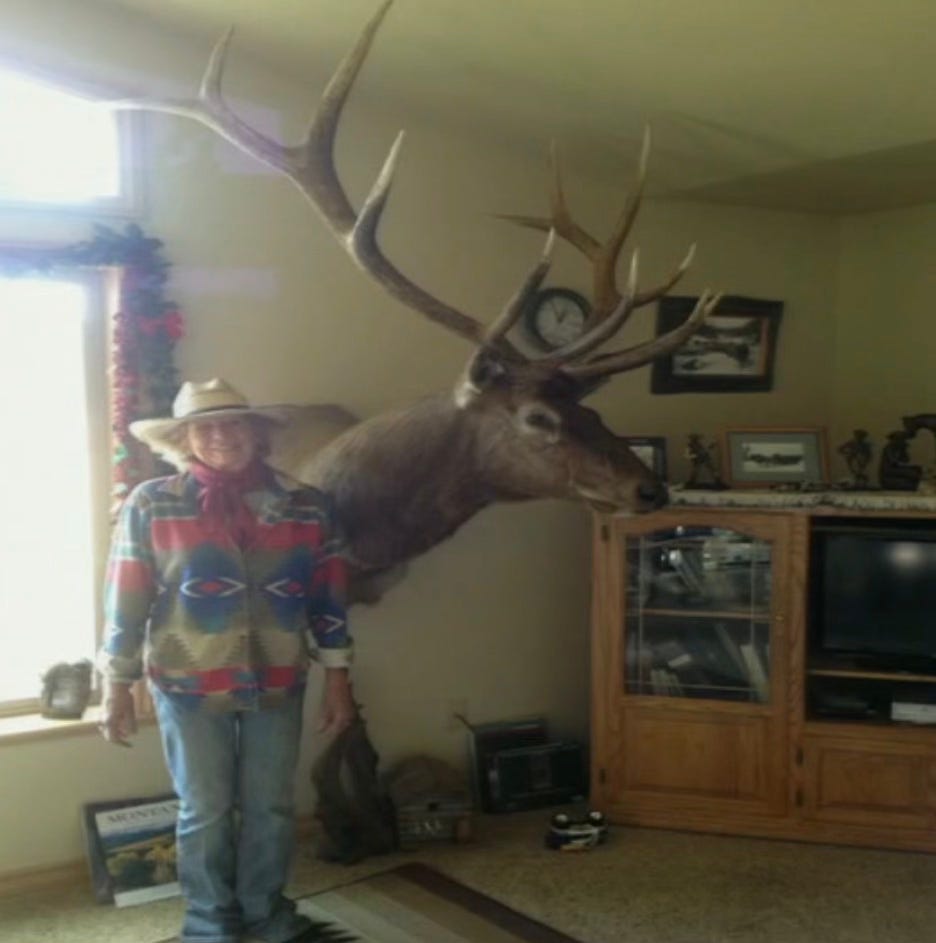
A mounted bull elk hung in one room, its antlers nearly touching the low ceiling. The rack was impressive, but what I remember most was the way the room was arranged. From across the house, you found yourself staring directly into the elk’s eyes while surrounded by photographs of the people who had built their lives around the country beyond the front door.
As the tea steeped, the stories began.
Looking back now, it occurs to me that the thirty acres along the Blackfoot River were only part of what I acquired during those first years in Montana.
The land was important. It gave me a place to build a cabin, hunt, fish, and begin putting down roots in a part of the world that felt increasingly like home. But land alone cannot teach a person much about a place.
People do that.
Over cups of tea at a kitchen table worn smooth by decades of use, Mary Faith introduced me to a Montana that existed long before I arrived. Through stories about horses, outfitters, wilderness battles, irrigation water, grizzly bears, and the families who built lives in that country, she quietly helped me understand the place I had chosen to call home.
At the time, I thought I had purchased raw land on a river — a place to start a new life.
What I failed to recognize was that I had stumbled into something far more valuable.
The land brought me to Montana.
People like Mary Faith convinced me to stay.
Editor’s Note: Mary Faith Hoeffner passed away in 2015 at the age of eighty-three.
Today, a memorial honoring Kenny and Mary Faith Hoeffner of K Lazy Three Ranch and Wilderness Outfitters stands in Memorial Park in Lincoln, Montana—a reminder of two people whose lives became woven into the history of the Blackfoot Valley and the wilderness country beyond.
On the day of her funeral, members of the Hoeffner family saddled their horses and rode to the old cemetery in Lincoln.
Among the horses was Mary Faith’s favorite buckskin. Her saddle rested in its usual place. Her hat sat on the saddle horn.
No one rode him.
The buckskin followed behind the family as they made their way to the cemetery.
###
Thank you! This is a wonderful view of Montana & its rich land. More importantly, a warm introduction to Mary Faith. I fully understand your attachment to Montana, beyond its beauty.